
In recent decades, the phenomenon of migration has become a subject of intense public debate in Romania. In the context of regional and global crises, as well as domestic labor shortages, Romanians' perceptions of immigrants and the diaspora are essential for shaping coherent public policies.
Two opinion polls conducted by INSCOP Research in April and September 2024 provide a clear picture of how the Romanian population assesses the impact of migration on society.
Romanians' Attitude Towards Immigration: Between Caution and Openness
According to data collected in April 2024:
- 23.4% of respondents believe that immigrants from the Middle East pose a major threat to Romania. However, 68.6% do not share this alarmist perception.
- 21.1% perceive immigrants from Ukraine as a significant threat, while 72.2% do not see them as a danger.
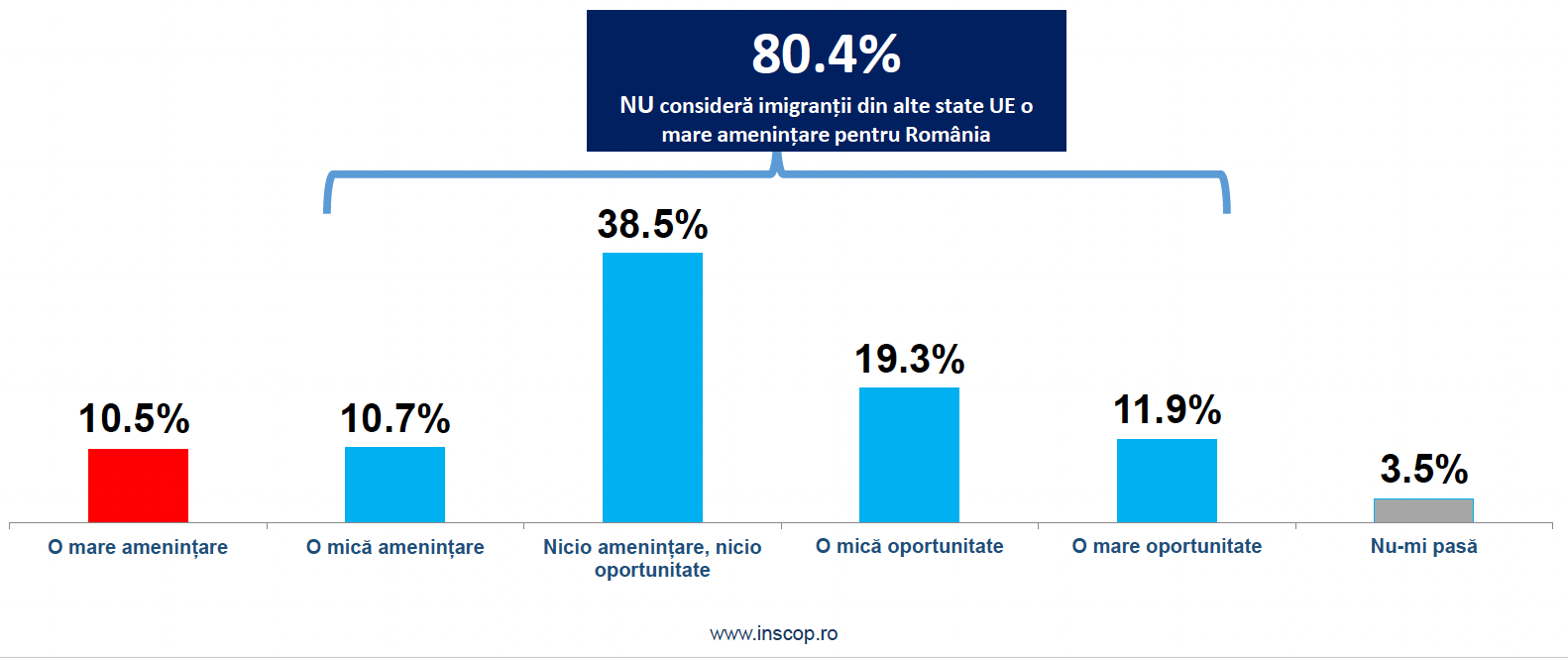
- As regards immigrants from other EU Member States, only 10.5% of respondents consider them a major threat, while 80.4% do not associate them with a major risk.
These results suggest a clear difference in public perception depending on the origin of immigrants, with a higher degree of trust being placed in those from Europe.
Economic Immigration: Between Mistrust and Pragmatic Solution
The September 2024 survey also addressed the issue of economic immigration. When asked about their perception of immigrants coming to Romania to work:
- 68.1% of Romanians consider them to be an opportunity, as they fill vacant jobs.
- Only 25.1% say that immigrants pose a threat because they compete with the local workforce.
These data reveal a growing openness to the integration of immigrants into the labor market, especially in the context of the increasingly acute shortage of personnel in certain economic sectors.
Repatriation of the Diaspora – a National Goal
Another important aspect of the research concerns attitudes toward Romanian citizens who have moved abroad. A significant proportion of the population (67.4%) believes that the Romanian state should offer financial incentives to encourage them to return to the country.
This opinion expresses both an appreciation of the human capital of the diaspora and a need to reconsolidate the ties between the state and its citizens who have left.
Conclusions
Romanians' perceptions of migration indicate a balanced approach based on differentiation rather than rejection. While there are reservations about certain groups of immigrants, most respondents are open to their integration, especially when their contribution is perceived as beneficial to the economy.
At the same time, Romanians want the diaspora to be valued and supported in order to return to the country, which signals the opportunity to develop active repatriation policies.
It is essential that policymakers take these perceptions into account when formulating national strategies on migration and integration. An approach based on data, not fears, can transform the challenges of migration into opportunities for sustainable development.
Sources:
Data extracted from INSCOP Research surveys conducted in April and September 2024. The studies were conducted on nationally representative samples using the CATI method (telephone interviews), with a margin of error of ±2.95% at a 95% confidence level.